Face Re-morphing: Differential Morphing Attack Detection via Feature-Space Similarity Changes
Abstract
Face morphing attacks pose a serious threat to face recognition systems because a single morphed document image can be matched to multiple contributors. Differential morphing attack detection addresses this threat by comparing a document image with a trusted live image, but existing methods often rely on static feature differences, constituent-face reconstruction, or multi-cue fusion.
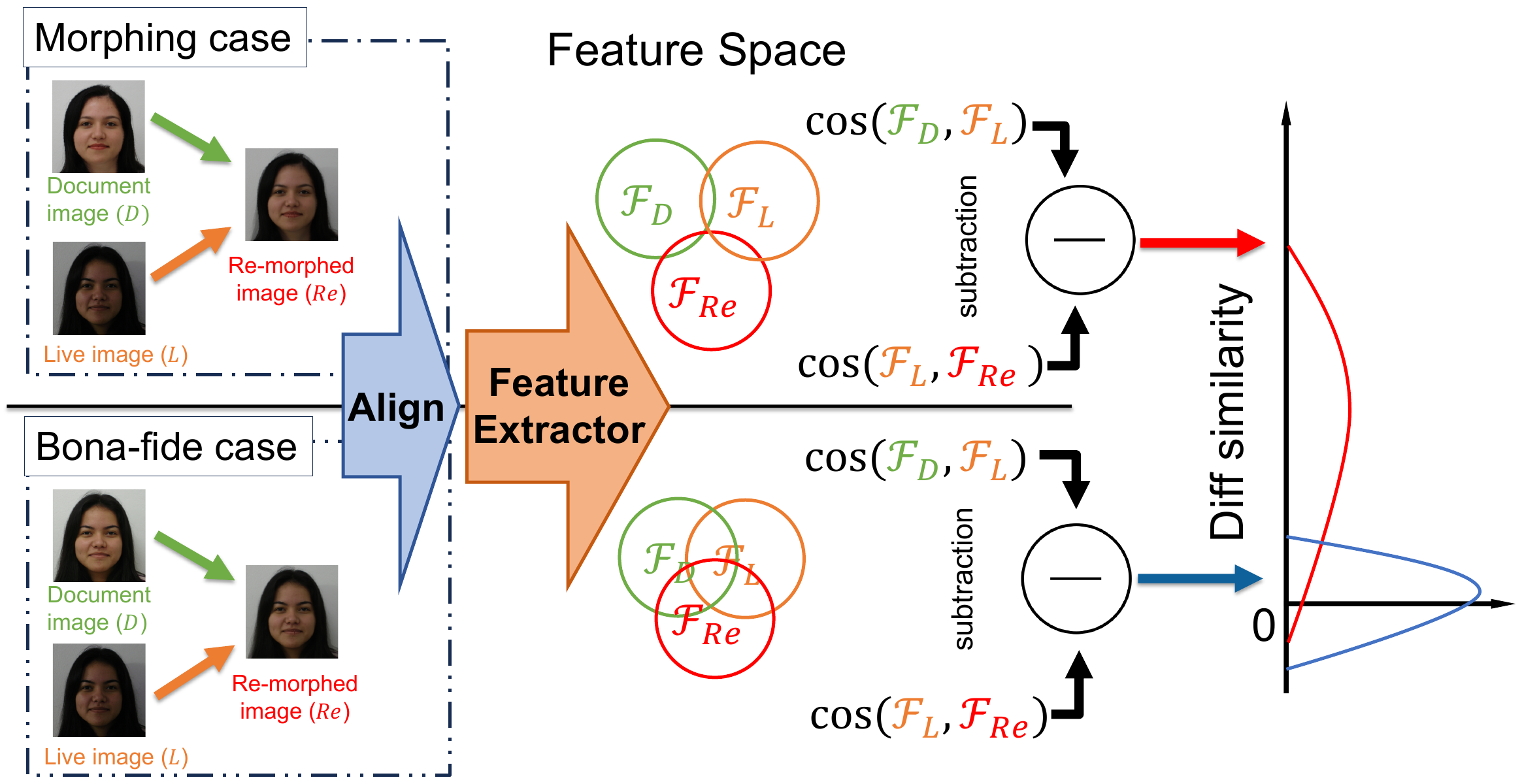
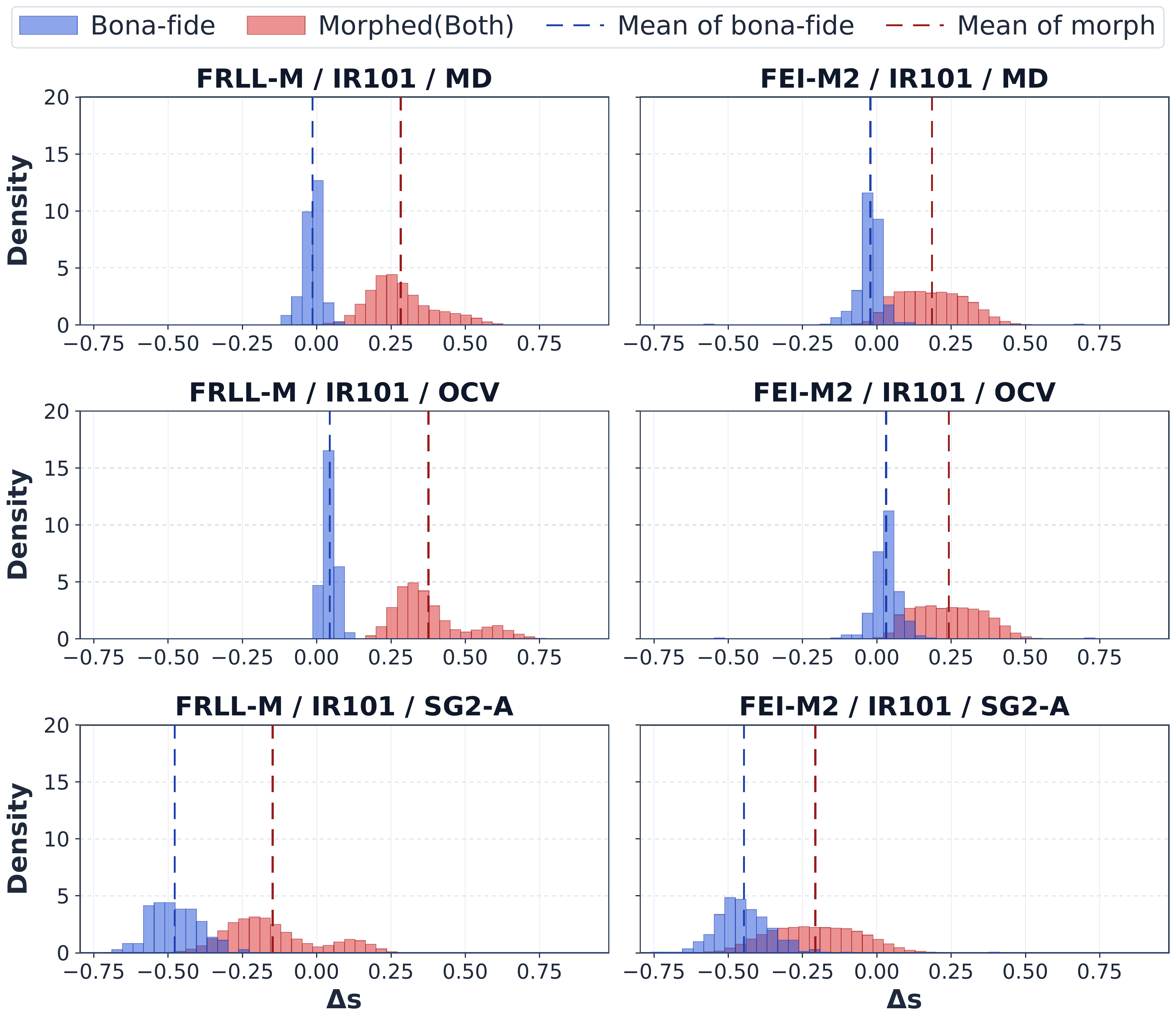
Face Re-morphing uses the feature-space response to an additional morphing operation as a detection cue. Given a document image and a trusted live image, the method generates a re-morphed image and computes the similarity change between the original pair and the live-re-morphed pair. Experiments on FRLL-Morphs and FEI Morph show that this re-morphing-induced similarity change provides a complementary cue for D-MAD.
Method
A document image D and a trusted live image L are aligned, and a re-morphed image Re is generated using a morphing method such as MorDIFF, OpenCV landmark morphing, or StyleGAN2-ADA. A face feature extractor maps the three images to embeddings and computes:
Bona-fide pairs are expected to remain near the same identity cluster after re-morphing, while morphing attack pairs tend to move toward the live contributor in feature space.
Key Results
FRLL-Morphs
OpenCV re-morphing achieved mean EERs around 0.001 across the reported Accomplice, Criminal, and Both conditions.
FEI Morph Version 2
MorDIFF and OpenCV produced low error rates in the Criminal condition, while the Accomplice condition remained more challenging.
Comparison
On AMSL, the OpenCV setting reported EER and B0.01 values of 0.000 under the evaluated protocol.
Similarity Change Distributions
Paper
BibTeX
@inproceedings{jin2026face_remorphing,
  title = {Face Re-morphing: Differential Morphing Attack Detection via Feature-Space Similarity Changes},
  author = {Jin, Jie and Nishigaki, Masakatsu and Ohki, Tetsushi},
  booktitle = {Proceedings of the International Joint Conference on Biometrics (IJCB)},
  year = {2026},
  eprint = {2608.13858},
  archivePrefix = {arXiv},
  primaryClass = {cs.CV},
  url = {https://arxiv.org/abs/2608.13858}
}